

Shaping sustAInable & ethical innovation in life sciences
AI has entered the lab. Now what?
Artificial intelligence is rapidly transforming life-science research — from analysing increasingly complex datasets and identifying potential drug candidates to supporting experimental design and accelerating scientific discovery. But as AI moves from bit to bench, important questions arise: How reliable are AI-generated insights? What role should open and high-quality data play? And how can AI-assisted science remain sustainable, ethical and trustworthy?
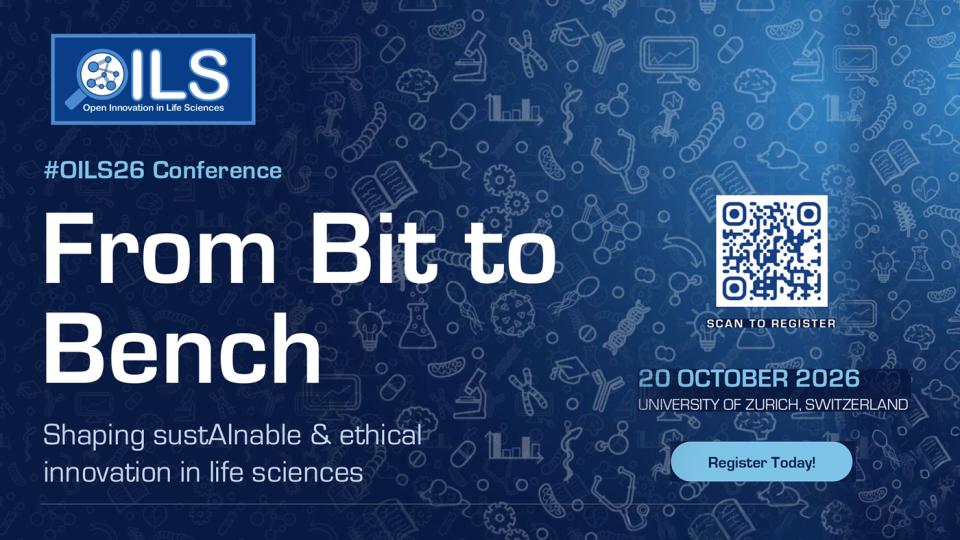
These questions are at the centre of OILS26 – From Bit to Bench, taking place on 20 October 2026 at the University of Zurich, Switzerland. Under the theme “Shaping sustAInable & ethical innovation in life sciences,” OILS26 brings together researchers, innovators, entrepreneurs, students and industry representatives to explore how AI is reshaping the life sciences — and how this transformation can be guided responsibly.
OILS26 – From Bit to Bench takes place on 20 October 2026 at the University of Zurich.
From open data to AI-assisted science OILS26 approaches the opportunities and challenges of AI in life sciences from several complementary perspectives.
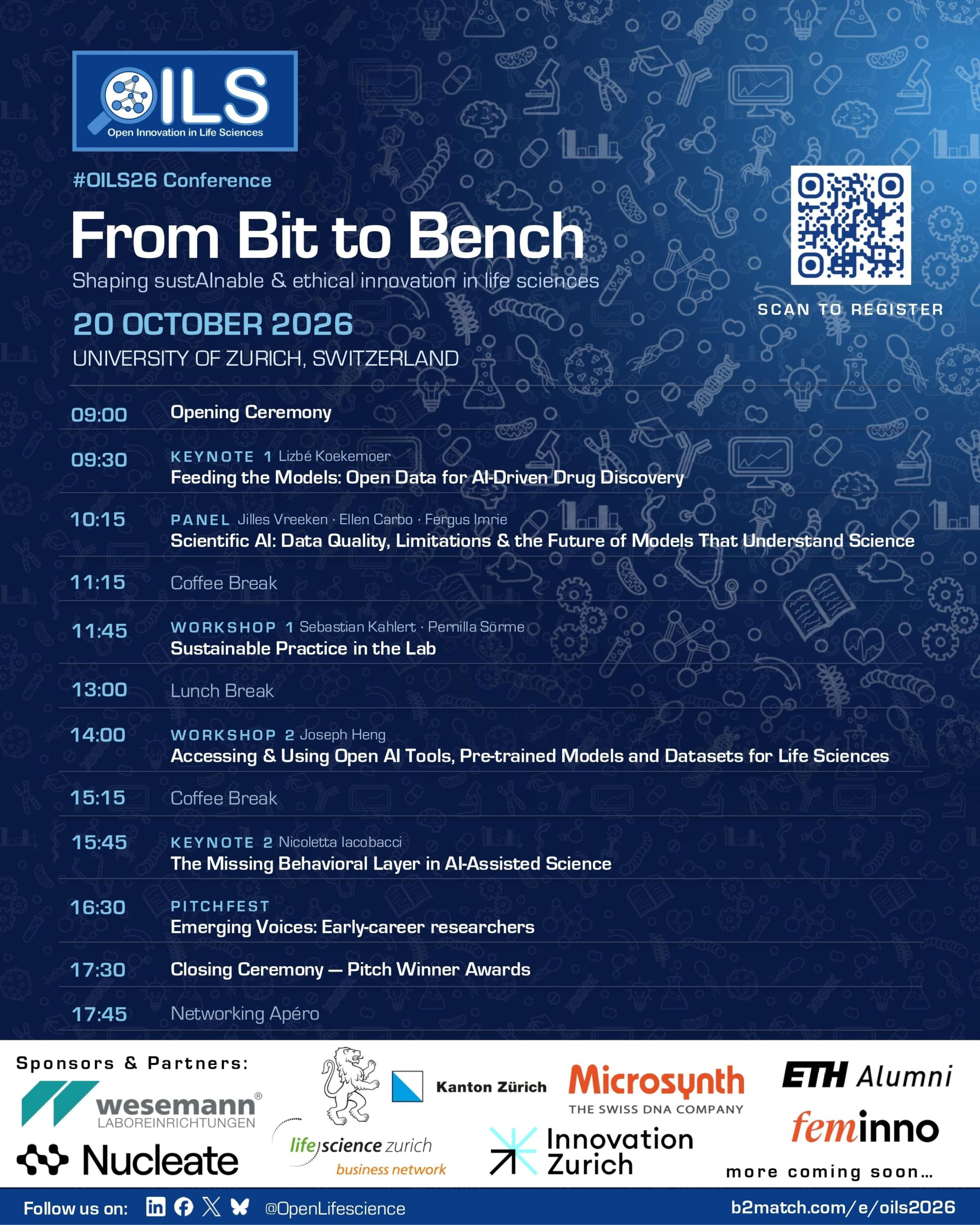
The conference opens with a keynote by Lizbe Koekemoer, “Feeding the Models: Open Data for AI-Driven Drug Discovery.” The session will explore the increasingly important role of accessible, reusable and high-quality scientific data in enabling AI-supported research and accelerating drug discovery.
This will be followed by the panel discussion “Scientific AI: Data Quality, Limitations & the Future of Models That Understand Science”, with Jilles Vreeken, Ellen Carbo and Fergus Imrie. The panel will address some of the fundamental questions surrounding scientific AI: What can current models already achieve? Where are their limitations? How does the quality of underlying data affect their results? And what will be required before AI systems can make increasingly reliable contributions to scientific discovery?
Together, the sessions move the discussion beyond the question of what AI can do towards the equally important question of what is needed to use it responsibly and effectively in scientific practice.
Hands-on exploration of sustainable science and open AI
OILS26 is not only about discussing AI. Two workshops give participants the opportunity to explore practical approaches that can be applied in research.
The first workshop, “Sustainable Practice in the Lab,” led by Sebastian Kahlert and Pernilla Sörme, focuses on sustainability in scientific practice. From laboratory operations and resource use to data storage and computationally intensive research, sustainability is becoming an increasingly important consideration throughout the scientific workflow.
In the afternoon, Joseph Heng will lead the workshop “Accessing & Using Open AI Tools, Pre-trained Models and Datasets for Life Sciences.” Participants will explore how existing open AI resources can be accessed and incorporated into life-science applications, helping to bridge the gap between rapidly evolving AI capabilities and their practical use by researchers.
Beyond technology: the human side of AI-assisted science Technological capability alone does not determine how AI will shape science.
In the afternoon keynote, Nicoletta Iacobacci will address “The Missing Behavioral Layer in AI-Assisted Science.” As AI becomes increasingly embedded in scientific workflows, questions of human behaviour, trust, responsibility and ethics become inseparable from questions about algorithms and data.
How researchers interact with AI tools, how institutions establish appropriate practices and how responsibility is shared between humans and automated systems will be crucial in determining whether AI-assisted science ultimately strengthens scientific research.
OILS26 therefore places technological innovation within a broader discussion about the scientific practices and values that should accompany it.
A platform for emerging researchers Early-career researchers are once again an important part of the OILS programme.
The OILS26 Pitch Fest – Emerging Voices provides researchers with an opportunity to present their work to an interdisciplinary audience and make connections beyond their immediate research environment.
The Pitch Fest is designed not only as a presentation format, but also as an opportunity to exchange ideas, communicate research across disciplinary boundaries and identify potential collaborators from academia, innovation and industry.
Selected contributions will be presented during the afternoon session, followed by the Pitch Winner Awards at the closing ceremony.
The abstract submission deadline for the OILS26 Pitch Fest is 15 October 2026.
Connect, discuss and collaborate
A central idea behind Open Innovation in Life Sciences is that innovation rarely happens within one discipline or institution alone. OILS26 therefore creates space not only for formal presentations but also for conversations and new connections between researchers, students, innovators, entrepreneurs and industry representatives working across AI and the life sciences.
Coffee breaks, discussions and the Networking Apéro at the end of the conference provide opportunities to continue conversations started during the sessions, exchange ideas and explore potential collaborations.
For participants unable to travel to Zurich, online participation will also be available.
Programme and registration: HERE
Registration open until 20 Oct 2026
Socials:
Follow our page @OpenLifeScience on LinkedIn, Facebook, Twitter and Bluesky for updates on speakers, program details, and highlights.